


The Witcher franchise has always been defined by its ability to blend emotional depth, rich worldbuilding, and moral complexity into unforgettable RPG experiences. After nearly a decade without a new mainline entry, anticipation for the next chapter has grown beyond simple excitement. Fans have wondered how the series could evolve in a post-Geralt era without losing the identity that made it iconic.
That question became far more intriguing following The Game Awards 2024, when CD Projekt Red unveiled The Witcher 4 with a stunning cinematic that spotlighted Ciri in a grim, folkloric tale of sacrifice and fear. The reveal confirmed not only a shift in protagonist but a shift in tone, direction, and ambition.
This article breaks down everything we know so far: the narrative approach, design philosophy, gameplay innovations, technology behind Unreal Engine 5, and what Ciri’s new role means for the future of the franchise. By the end, you will have a clear, expert-informed understanding of how The Witcher saga is reinventing itself for a new era.
A New Beginning: Ciri Takes the Lead
The most significant shift in The Witcher 4 is its protagonist. After three games following Geralt’s journey, CD Projekt Red is passing the torch to a character who has been central to the story all along.
Protagonist Shift
For the first time in the mainline series, Geralt of Rivia steps aside as the protagonist, handing the reins to Cirilla Fiona Elen Riannon, or Ciri. Game Director Sebastian Kalemba explained that the choice felt natural, stating that “the story has always been about her.” Executive producer Małgorzata Mitręga echoed this sentiment, describing the decision as “the very organic, logical choice” for continuing the saga.
The reveal trailer shows Ciri has completed the Trial of the Grasses—the painful mutation process that transforms witcher apprentices—evidenced by her signature feline eyes and enhanced reflexes. She wields her iconic sword Zireael and introduces a new magic chain weapon reminiscent of Geralt’s fight with the Striga from the first game’s trailer. As of mid-2025, over 440 developers are dedicated to this project, ensuring ambitious scope for Ciri’s journey.
Narrative Direction
The narrative pivots to Ciri’s journey as she truly becomes a Witcher, exploring themes of inheritance, sacrifice, and defiance against fate. Kalemba explained that because Ciri is younger than Geralt, players will have more freedom to shape her character: “She’s about to actually form her own codex, but on her own terms. The way she actually deals with the monsters, the way she deals with quests, the adventures, it’s her own unique way.”
Importantly, no canon ending from The Witcher 3 will be enforced, making the game accessible to newcomers while rewarding longtime fans. Though the trailer suggests CD Projekt Red has made certain narrative choices about Ciri’s path post-Witcher 3, the developers have emphasized this is a continuation rather than a direct sequel requiring intimate knowledge of previous games.
The World of The Witcher IV
Beyond the protagonist shift, The Witcher 4 promises to expand the series’ already rich world with new locations and environmental depth that pushes the boundaries of what the franchise has achieved before.
New Regions
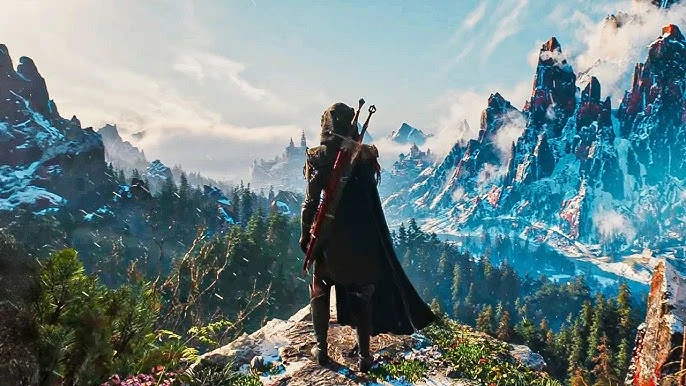
The Witcher 4 expands the Continent with previously underexplored areas. The reveal trailer depicts what appears to be a remote northern village surrounded by dense forests and harsh wilderness, suggesting the game will venture into new territories beyond familiar locations like Novigrad or Skellige. The village represents the kind of precarious human settlements that exist on the edges of civilization—places where ancient traditions and superstitions still hold sway, and where the line between monster and human becomes disturbingly blurred.
Environmental Design
Environmental fidelity reaches new heights with Unreal Engine 5 technology. The cinematic was pre-rendered using assets and models from the game itself, powered by the same customized Unreal Engine 5 build being used for development. This design philosophy emphasizes precarious human settlements amid monstrous dangers, fostering moral dilemmas where environments influence gameplay meaningfully, from traversal challenges to the way monster hunts unfold based on terrain and weather conditions.
Gameplay Innovations
While CD Projekt Red has kept specific mechanics under wraps, the reveal trailer and developer statements hint at significant evolution in how players will experience The Witcher’s trademark combat and exploration.
Combat System
While specific gameplay details remain closely guarded, the reveal trailer offers glimpses of combat innovations that build on the series’ fluid foundation while adapting to Ciri’s nimble fighting style. The trailer showcases faster-paced engagements with Ciri wielding her sword and a new magical chain weapon that appears to offer both offensive capabilities and crowd control options. She’s shown drinking a witcher potion to enhance her reflexes during combat, suggesting the series’ traditional preparation and alchemy systems will return in evolved forms.
Magic and Abilities
Ciri’s unique Elder Blood powers will likely form a core part of the magic systems. The reveal trailer showcases advanced magical abilities beyond what traditional witchers possess, hinting at gameplay mechanics that could include teleportation, time manipulation, or dimensional powers that create strategic advantages in both combat and exploration. CD Projekt Red has emphasized that the game will feature “new gameplay elements and new mechanics” not seen in previous Witcher titles.
Open-World Dynamics
The open world promises reactive ecosystems and branching consequences, where decisions ripple across regions. The game maintains a pure single-player focus—CD Projekt Red has explicitly stated there are no multiplayer plans allowing for maximum immersion through dynamic events and player-driven narratives. The developers have taken a “more console-first development” approach, ensuring optimized performance across platforms from the start.
Technical Advancements
The switch to Unreal Engine 5 represents more than just a new graphics gmae engine it’s a fundamental shift in how CD Projekt Red approaches game development, with implications for both visual quality and long-term support.
Unreal Engine 5
Switching from CD Projekt Red’s proprietary REDengine to Unreal Engine 5 enables cutting-edge features like Nanite for detailed geometry and Lumen for global illumination. The reveal trailer was pre-rendered using a custom build of Unreal Engine 5, showcasing the visual fidelity the team is targeting for actual gameplay. Epic Games has specifically highlighted The Witcher 4’s use of Nanite Foliage technology as instrumental in achieving both visual quality and the performance target of 60 FPS with ray tracing on PlayStation 5.
Performance Optimization
Prioritizing stability and learning from past launches, CD Projekt Red is targeting 60 FPS performance on base PlayStation 5 hardware while maintaining visual fidelity. The studio has explicitly stated that no generative AI is being used in development, preserving the handcrafted authenticity that defines their games.
Release Date and Platforms
While fans are eager for concrete dates, CD Projekt Red is taking a measured approach to announcing when and where players will experience Ciri’s journey.
Expected Launch
As of late 2025, The Witcher 4 is in full production but lacks a firm release date. CD Projekt Red has officially ruled out a release before the end of 2026. Based on development timelines, industry analysts estimate a launch window of 2027 or potentially 2028. Joint CEO Michał Nowakowski stated that following Cyberpunk 2077’s troubled launch, CD Projekt Red will not engage in a “mass attack” marketing campaign until developers are absolutely certain the game is ready.
The development team has steadily grown throughout 2024 and 2025, reaching over 440 developers by mid-2025, representing more than half of CD Projekt Red’s total development resources.
Supported Platforms
The game targets PC, PlayStation 5, and Xbox Series X/S, with development focused squarely on current-generation hardware. There has been no mention of PlayStation 4 or Xbox One versions. The console-first development approach ensures that all platforms receive equal attention from the beginning of production.
What’s Next? The Future of The Witcher Saga
The Witcher 4 isn’t just a single game it’s the beginning of an ambitious new chapter that will define CD Projekt Red’s vision for the next decade and beyond.
Trilogy Plans
The Witcher 4 launches a new trilogy, with CD Projekt Red committing to expanding the universe through sequels that continue Ciri’s story arc. The studio’s ambitious roadmap includes Project Sirius a multiplayer-focused Witcher experience and Project Canis Majoris, a remake of the original Witcher game. Additionally, CD Projekt Red is developing Cyberpunk 2 (with over 115 developers) and Project Hadar, a completely new IP. This ambitious slate aims to redefine RPG expectations over the next decade.
Community Expectations
The Witcher 4 stands at a defining crossroads for the franchise. With Ciri stepping into the lead role and CD Projekt Red embracing Unreal Engine 5, the next chapter promises a bold transformation rather than a nostalgic retread. While many details remain under wraps, the reveal shows a studio focused on narrative depth, world cohesion, and meaningful evolution rather than spectacle for its own sake. If delivered with the care shown so far, this could become another generational benchmark for RPG storytelling.
As someone who has followed the series for decades, this shift feels both risky and necessary. Geralt’s story was beautifully concluded, and Ciri offers a completely new lens through which the Continent can grow. If CD Projekt Red can balance innovation with emotional authenticity, The Witcher 4 may not only honor the franchise’s legacy but redefine what modern fantasy RPGs can be.