


Game Design Psychology is the craft of turning human attention, emotion, and action into playable systems—and knowing when not to. For developers, it’s where cognitive science meets production realities: deadlines, constraints, and players with a thousand other apps begging for their time. In this piece of Polydin Game art studio, we translate Game Design Psychology into tools you can apply today: how motivation actually works in games, why player types matter (and when they don’t), how loops become habits, and how to build experiences that respect players as people, not just metrics.
The Psychological Foundations of Game Design
At its core, design is the arrangement of choices. Psychology explains why those choices feel compelling or confusing, fair or unfair. Attention is scarce; memory is messy; emotions color our judgments. Good games lean into these truths with clarity and kindness. This foundation informs everything from your tutorial pacing to your live-ops economy.
Motivation
Motivation in games sits on two rails: intrinsic (play for its own sake) and extrinsic (play for rewards). Intrinsic motivation thrives on autonomy (meaningful choices), competence (a climbable learning curve), and relatedness (social belonging). Extrinsic motivation—currencies, cosmetics, rank—works best when it amplifies intrinsic drives rather than replacing them. If a reward feels like a leash rather than a celebration, players notice. Practical tip: pair every extrinsic reward with an intrinsic milestone (“new movement tech mastered,” “strategy discovered”). Your progression then reads as personal growth, not just treadmill distance.
Player Types According to Bartle
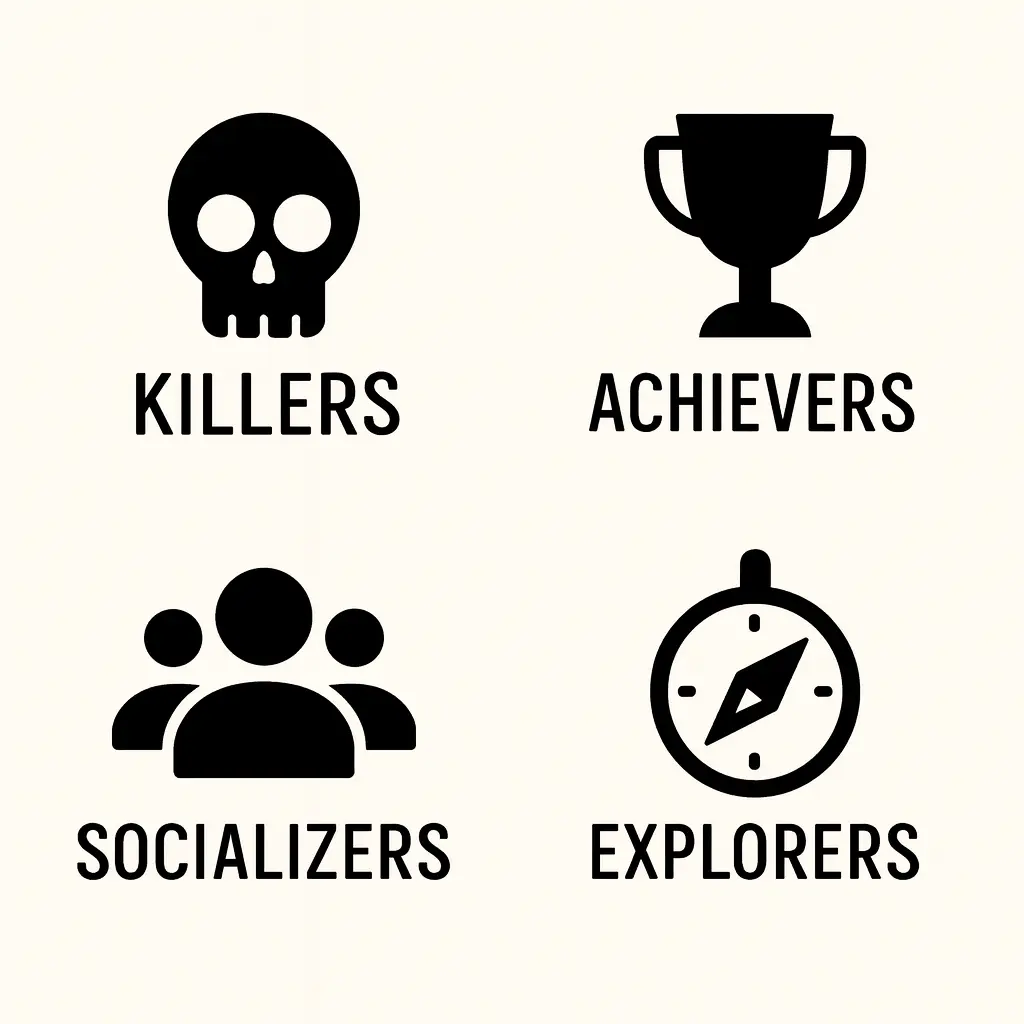
Bartle’s taxonomy—Achievers, Explorers, Socializers, Killers—remains a useful lens for multiplayer and sandbox systems. Achievers respond to measurable progress; Explorers to secrets and systems; Socializers to people-first features; Killers to dominance and disruption. The model is a compass, not a cage: most players blend types depending on context (ranked vs. casual, solo vs. party). Use it early for feature ideation (What does each type do minute-by-minute in our world?) and later for telemetry sanity checks (Which type is underserved in the first session?).
Game Mechanics
Game Mechanics are verbs plus rules: jump with cooldown, craft with recipes, draft with mana curve, shoot with recoil. Psychology asks: How readable is the state before and after a mechanic fires? Does the feedback help players form accurate mental models? Are failure states legible enough to invite “one more try”? Clear verbs, stable physics, and consistent affordances reduce cognitive overhead, letting emotion and mastery take center stage.
Read Also: Decoding the Psychology of Colors in Games
Game Design Frameworks and Player Behavior Loops
Behavior loops are the heartbeat of play: trigger → action → feedback → meaning → memory. The “meaning” step is often skipped in docs but felt by players; it’s where feedback becomes a story about the self (“I am getting better,” “I helped my squad,” “I trolled the meta”). Design loops that create identities players are proud to inhabit. When loops drift into obligation, they stop being play.
MDA Framework
MDA—Mechanics, Dynamics, Aesthetics—reminds us the designer touches Mechanics, the player experiences Aesthetics, and Dynamics emerge in between. Treat MDA like a contracts document:
-
Mechanics contract: deterministic, testable rules.
-
Dynamics contract: predictable patterns under pressure (kiting, camping, snowballing).
-
Aesthetics contract: the feelings you intend (challenge, fellowship, discovery, expression, submission/relaxation, narrative, fantasy, sensation).
Bake MDA into your review ritual. For every new mechanic, write the expected dynamic and the target aesthetic in one sentence. If QA or playtests observe different dynamics, change the mechanic—don’t argue with reality. This tightens your feedback loop and keeps Game Design Psychology practical, not theoretical.
Compulsion Loops and Reward Systems
Compulsion loops are just behavior loops with a slot-machine accent: variable rewards, near-misses, streaks. They’re powerful, but power demands ethics. Use variability to add wonder and replayability, not to obscure expected value. Combine fixed and variable schedules: guarantee progress (pity timers, stamp cards) while keeping surprise (rare drops, emergent events). Communicate odds clearly. When rewards respect player time, long-term retention improves because trust is retention’s real currency.
Flow, Cognitive Load and Feedback Loops
Flow lives between boredom and anxiety. To keep players in the channel:
-
Titrate challenge: adaptive difficulty, generous aim-assist ramp, or enemy composition that whispers “you can win—if you learn.”
-
Manage cognitive load: limit simultaneous information, chunk tutorials, surface only the decisions that matter now. Hick’s Law (more choices = slower decisions) and Fitts’s Law (distance and size affect targeting speed) are not just UX trivia; they shape your combat readability and menu friction.
-
Close the loop: timely, layered feedback (audio, animation, UI) tells the brain, “Action registered; here’s what changed; here’s what to try next.”
Enhancing Game Experience with Psychological Insights
Small psychological tweaks create outsized effects. Name your difficulty modes with dignity (“Story,” “Adventurer,” “Veteran”) to reduce ego barriers. Use progress bars with visible tick marks; humans are motivated by nearing milestones. Frame retries as experiments (“Try a new route?”) to convert failure into curiosity. And always audit friction: friction that protects players (confirmation on premium spend) is good; friction that pads KPIs is noise.
Player Behavior Patterns: The Bartle Test Explained
The Bartle Test is a survey that maps players to the four types. Treat it as a conversation starter, not a verdict. Use it to personalize onboarding paths (Explorers get early side routes; Achievers see clear quest ladders; Socializers find friend-suggest surfaces; Killers preview competitive modes with robust rules).
More importantly, design cross-type bridges: give Achievers reasons to interact with Socializers (guild achievements), Explorers to help Killers (intel for PvP ambushes), and so on. Mixed ecosystems are healthier and more resilient to churn.
Designing with Usability in Mind
Usability is empathy operationalized. Prioritize:
-
Readability: color contrast, silhouette clarity, animation anticipation.
-
Consistency: input grammar that remains stable across modes; no reinvented buttons without overwhelming payoff.
-
Affordances: interactive elements look touchable/clickable; “you can wall-run here” is visually obvious.
-
Accessibility: remappable controls, scalable text, captions with speaker tags, colorblind-safe palettes, and difficulty assists that don’t shame.
-
Learnability: progressive disclosure—teach only what the player needs when they need it; embed tooltips in actions, not walls of text.
Emotion and Engagement in Game Design
Emotions are not just outcomes; they are levers. Build arcs at multiple scales: the 10-second taste of power, the 10-minute mission rhythm, the 10-hour season narrative. Vary tension and release; give players chances to cool down, share, and reflect. Engagement deepens when players feel seen and when the game occasionally surprises them without violating its own rules.
Emotional Triggers
Key triggers include curiosity (mysteries, fog of war), mastery (visible skill ceilings), social proof (performances that others can witness), and moral choice (consequences that echo). Use surprise sparingly and fairly; “surprising but inevitable” beats “gotcha.” Remember: reliable feedback amplifies all triggers by letting players attribute outcomes to their decisions.
Narrative Psychology
Players build stories about themselves through play. Identity-safe narratives (the rogue who becomes a leader, the pacifist who solves a fight with wit) keep people invested. Provide scaffolding—codex entries, character barks, environmental storytelling—but leave room for player-authored meaning. Avoid false agency: choices that pretend to matter but don’t. It teaches players not to care.
Social Presence and Connection
Humans regulate emotions socially. Co-op turns frustration into laughter; competition turns skill into status. Design social presence intentionally: ping systems for low-friction coordination, commendations for prosocial acts, and clear rules around ranked toxicity. Give teams rituals (ready checks, shared emotes) that create micro-bonds. Celebrate collaboration as loudly as individual heroics.
Case Studies & Real-World Examples
Case studies are most useful when we extract portable patterns: specific, repeatable decisions you can apply in your context.
Among Us
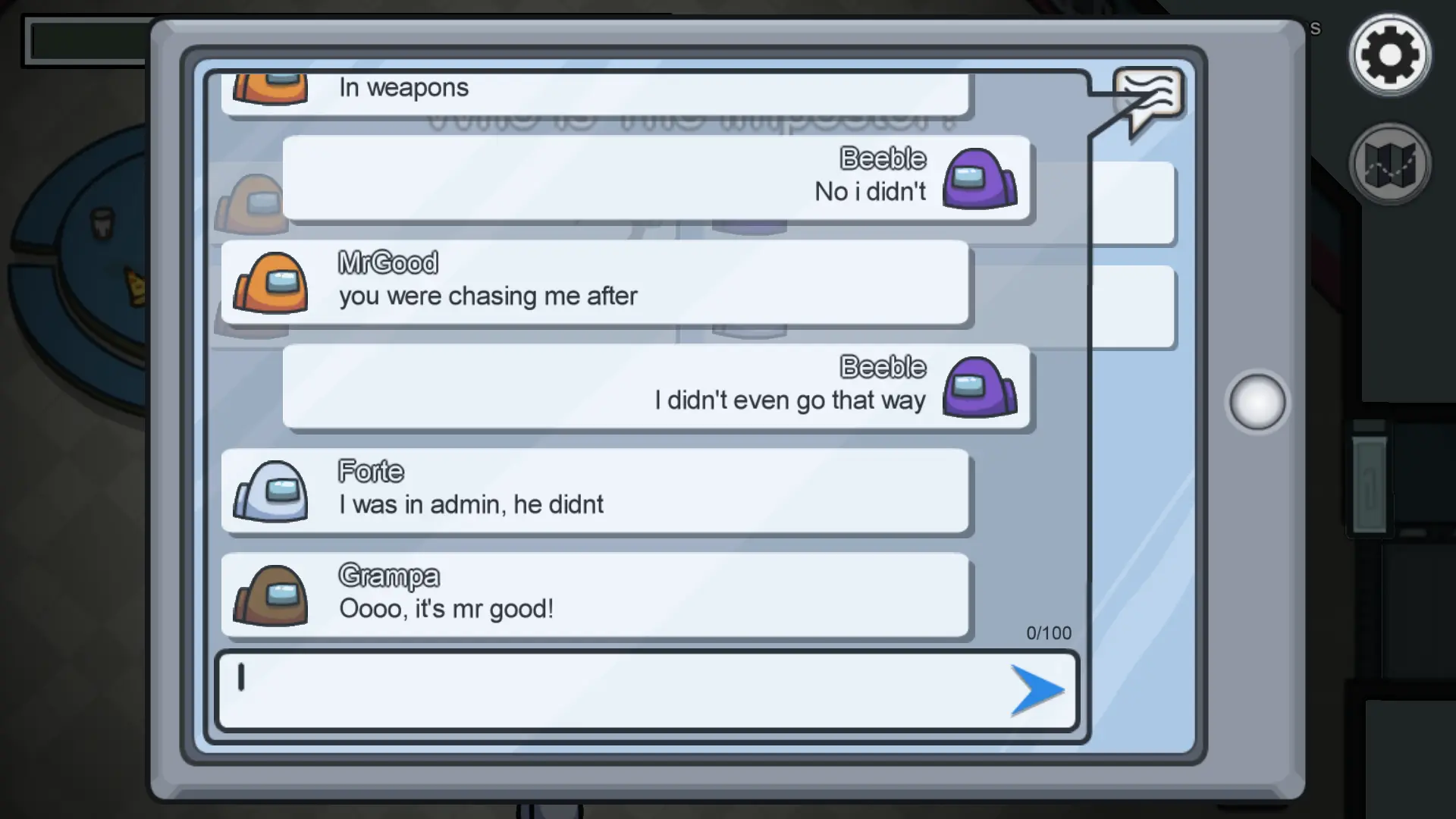
Among Us succeeded by lowering the social deduction barrier. Sessions are short; rules are teachable in a sentence; tasks provide cover for conversation. The core loop is pure psychology: deception detection through body language, timing, and alibis. Notably, cognitive load is controlled: maps are simple, tasks are repetitive on purpose, and the emergency meeting provides a clean phase change from action to debate.
The lesson: if your game’s magic is in human interaction, minimize mechanical clutter that competes with talk. Also, the game embraces spectator appeal—Rounds produce sharable narratives (“Remember when Red vented in front of everyone?”). Designing for watchability, even indirectly, helps discovery and retention.
Riot Games
Riot invests heavily in behavioral design: clear penalties for harm (leaver penalties, chat restrictions), visible reinforcement for prosocial play (honor systems, teammate recognition), and broad tooling for detection. They frame rules as community values rather than draconian edicts, which shifts player interpretation from “punishment” to “maintenance of fair play.”
In design terms: norms are UX. Another transferable insight is their iteration cadence—small, frequent balance changes—communicated openly. When players see a studio respond to data and sentiment, trust compounds. That trust buys runway for risk (new agents, new modes) without fragmenting the audience.
League of Legends
League of Legends is a masterclass in layered mastery. The early game rewards basic competencies (last hitting, warding), midgame spotlights team strategy (objective trades, macro rotations), and lategame compresses decisions under pressure (Baron calls, base races). Each layer has distinct feedback: minion gold pings, objective timers, announcer calls.
Importantly, champion identities are psychologically legible—players form attachments not only to mechanics but to personas (the outplay assassin, the steadfast tank, the trickster mage). The ranking system then gives those identities a ladder to climb. Takeaway: provide multiple mastery tracks (mechanical, strategic, social), each with its own ceremonies of progress.
Ethical Considerations in Psychological Design
Ethics is not a postmortem slide; it’s a design constraint. If a technique works only when players misunderstand it, don’t use it. If an economy encourages spending beyond informed consent, redesign it. Transparency, player control, and restorative systems (easy refund windows, generous undo flows) are not just “nice to have”—they’re competitive advantages in an industry competing for long-term goodwill. Game Design Psychology, practiced responsibly, treats players as partners.
Dark Patterns to Avoid
Dark patterns exploit cognitive biases against player interests. Common offenders:
-
Obscured odds or unbounded spending in loot systems. Fix: disclose probabilities, cap spending paths, provide pity timers and deterministic alternatives.
-
Artificial FOMO through predatory timers (“buy in 59 minutes or lose progress”). Fix: rotate content fairly, keep earnable paths available, avoid manufactured regret.
-
Pay-to-fix-friction you created (energy bars that block core verbs). Fix: remove punitive gates; monetize expression or convenience that doesn’t undermine fairness.
-
Sticky UI traps (tiny close buttons, miscolored confirmation states). Fix: design honest affordances; confirm costly actions; make exits obvious.
-
Social blackmail (“Your friend loses rewards if you don’t log in”). Fix: reward collaboration without punishing absence.
Designing for Player Wellbeing
Wellbeing features are quality features:
-
Session design: natural stopping points after missions; gentle “call it a night?” prompts post-boss.
-
Progress pacing: daily/weekly goals that fit real lives; no streaks that punish illness or travel.
-
Cognitive safety: content warnings with customizable filters; aim and camera options to reduce motion sickness; colorblind modes from day one.
-
Time respect: evergreen earn paths; backlog-friendly events; catch-up mechanics that don’t undercut veterans.
-
Community health: strong reporting tools, fast feedback, and restorative systems (mutual unqueue, role swap prompts, new-player protection).
These choices reduce churn not because they hack brains, but because they honor them.
Conclusion
Game Design Psychology isn’t a bag of tricks; it’s a discipline of empathy guided by evidence. It asks us to define the feelings we intend, instrument the behaviors that create them, and iterate until player stories match our promises. Use models like MDA and Bartle as scaffolding, not scripture. Balance intrinsic motivations with fair rewards. Keep players in the flow channel by minding cognitive load and delivering crisp feedback.
Design social systems that make strangers into teammates, and economies that celebrate time rather than extract it. Most of all, treat ethics as design, not PR. If players walk away feeling smarter, braver, calmer—or just more themselves—you’ve done more than ship a game. You’ve created a space where people can practice being the versions of themselves they want to become. That’s the quiet power of Game Design Psychology—and it’s a power worth wielding well.